
Definitive guide
Webflow vs Wix
Webflow vs Wix Review 2026: The Ultimate Comparison
Finding the right website builder usually turns into a headache. You either get stuck with a platform that is easy but incredibly limiting, or one that gives you total freedom but requires a computer science degree to understand. Walk into any web design forum right now and you will see everyone arguing over the same two options: Wix and Webflow.
Look, both platforms promise to help you launch a great site. But they are built for entirely different people.
Wix is the ultimate tool for the weekend DIYer. You drag an image, drop it somewhere on the screen, hit publish, and you are done before dinner. Webflow is the exact opposite. It throws you straight into the deep end, acting more like a professional coding tool disguised as a design interface. It is built for people who lose sleep over a misaligned margin or a messy mobile layout.
If you are trying to figure out which one to actually use for your next project, forget the marketing pages. Let's talk about how these tools actually feel when you are deep in the building process.
The Editor
What does that mean for your workflow? Think about your business. You cannot rely on marketing promises when you are up at two in the morning trying to troubleshoot a broken layout before a major product launch.
Walk into any web design forum right now and you will see everyone arguing over the exact same options: Wix Studio and Webflow. They both promise to help you launch a stunning site, but they target completely different mindsets.
Let us bypass the marketing fluff and look at how these editors actually perform when you are deep in the building process.
The day to day building experience on these platforms comes down to how much you want the software to automate versus how much manual control you want over the underlying architecture. Wix Studio is Wix’s flagship professional platform now, built specifically for agencies and freelancers who found the classic Wix editor too limiting.
Forget the old days of just throwing text and images onto a page without a plan. The tool forces you into using structured sections, containers, and responsive grids from the start. You get a lot of help from their AI assisted responsive design tools and smart docking features when you need to scale layouts for different devices. Letting the platform assist with responsive docking and layout suggestions saves an enormous amount of time. But there is a catch. If a complicated layout breaks or scales weirdly, you still have to go in by hand. Overriding the automation means digging through a messy layer panel and adjusting docking settings manually, which turns into a massive headache real quick.
Webflow takes a completely different path, even though it is not totally against automation these days either. They have added their own AI tools, component libraries, and localization shortcuts recently to make things move faster. Even with those updates, the main canvas still functions like a direct visual interface for raw code. You really need to understand basic CSS logic here.
If you cannot wrap your head around things like the box model or flexbox alignment, you are going to struggle hard. Messing around with absolute positioning will just break everything if you do not know what is going on.
Learning the layout logic takes real effort since you cannot skip over web design mechanics here. Most layout styles, spacing, and classes are defined manually, giving you much more direct control over the design. If you are brand new to the platform, making a basic responsive navigation menu feels like it takes all day. But if you actually know what you are doing, Webflow's class inheritance lets you fly through the build. You get highly predictable layouts because you define the structure yourself. It makes it generally much easier to diagnose why a layout behaves differently across breakpoints because the styling rules are explicit.
What is the play here? The final verdict comes down to your production style and how much code architecture you want to manage.
Wix Studio focuses heavily on build speed. It uses automated systems, native app connections, and layout shortcuts so you can launch responsive client sites without building every layout rule from scratch. It is the better option if your business relies on quick turnaround times and massive volume.
Webflow is visual engineering. It requires a much stronger understanding of front end development principles and web design mechanics upfront. In return you get exceptional control over your site's structure, layout, styling, and responsive behavior. Pick Webflow if you refuse to let a software automated engine make design layout assumptions for you.
Ease of Use
Think about your actual daily operations. A tool that claims to be simple can quickly trap you when a client demands a quick layout change at the last second.
Wix Studio wants to get rid of the normal layout friction. The learning curve is pretty gentle. You need a contact form or a custom container? You find it in the side menu and throw it onto the canvas. The system handles much of the responsive layout work for you. Their responsive layout tools automatically adjust layouts across different screen sizes without forcing you to configure everything yourself. It works fine for the first couple of hours on a fresh project. But that automated help hides a lot of pain later. When the software engine scales a custom design unexpectedly, things get messy fast. Why deal with that? You find yourself fighting the software defaults. You will spend an hour wrestling with docking properties just to stop a logo from jumping over a text paragraph block. A quick change turns into an absolute battle against the app logic.
Webflow takes a much more manual approach, even though it now includes a growing set of AI and productivity tools. Ease of use here depends entirely on what you know about code structure. If you do not understand the CSS box model, you face one of the steepest learning curves among modern website builders. You cannot just drag a header across the screen because you feel like it. The canvas forces you to place it inside a container, add a class name, and type in your padding values manually. No shortcuts exist to mask those layout mechanics.
The payoff happens if you actually understand basic HTML and spacing rules. Webflow becomes incredibly fast. The layout engine executes exactly what you input. Why does that matter for your velocity? It means you are generally troubleshooting your own layout decisions instead of automated layout behavior. For an experienced builder, that explicit control is much easier to manage than a guessing canvas.
Look at your business timeline.
Wix Studio gets you a finished layout quickly because it takes care of the math. It is fast to learn and gets projects out the door before you lose momentum.
Webflow is only easy once you master front end web mechanics. The initial layout setup feels like a tedious chore, but it gives you far greater predictability when you need to fix a broken container across different device screens.
Ecommerce
Let us talk about the exact moment a customer pulls out their credit card. A gorgeous digital storefront is completely useless if the shopping cart lags or the payment processing mechanics fail during a sudden rush of sales.
Wix builds its entire ecosystem around transactional speed. You sign up, click a few buttons in the dashboard, and your store can immediately handle transactions using multiple payment providers and localized payment options. Managing variant stock levels, running bulk inventory updates, and setting up automated abandoned cart email templates happen natively inside one centralized screen. They have spent a lot of resources expanding their retail tools to include integrations with marketplaces and other sales channels out of the box.
But there is a massive wall here. The checkout page itself is highly standardized. If your business requires a heavily customized checkout flow, you will quickly run into platform limitations that Velo cannot fully overcome. You face immediate friction the second you try to step outside their pre-built commercial sandbox because checkout is intentionally restricted for security and platform consistency. Why accept those layout restrictions if you need a completely tailored purchase journey?
Webflow approaches online commerce from a different technical direction. They do not give you a completely headless setup natively. Instead, Webflow gives you extensive control over product pages, collection layouts, and the overall storefront design, allowing you to create a highly customized shopping experience before customers reach checkout. You use their component properties and style variables to build out the product grid architectures block by block. What does that mean for your design control? It means you have massive design authority over the initial storefront presentation. No automated engine is making layout assumptions for your product grids.
But that extreme frontend freedom hides a lot of back-end limitations. Webflow is simply not built to be a heavy enterprise inventory engine.
Natively managing thousands of tracking stock units or configuring complicated, multi-location shipping parameters can quickly become a nightmare. Furthermore, their native checkout is still largely hosted and standardized, meaning you cannot just redesign the entire checkout experience from scratch. You frequently find yourself forced to connect external automation tools or bypass their native system entirely by integrating third party software like Shopify to handle the heavy backend logistics. You are essentially paying for premium design customization on the front end while still needing outside tools to manage the actual fulfillment.
Think about your specific retail operations. Wix gives you a secure, fully functional retail engine right away because the logistics and payment rails are baked directly into the platform core. It is reliable and fast for standard business operations where a standardized checkout works fine. Webflow treats e-commerce as a high-end visual design challenge for the storefront itself. It demands significantly more technical wiring upfront and often requires third party help for heavy backend logistics, but it delivers exceptional design flexibility over the visual presentation of the buying journey before the customer hits the pay button.
Features
Wix approaches its features with an absolute maximalist strategy. Everything is packed right into the dashboard core. Need a fully functional client scheduling system? You activate their native bookings app. Need user roles, restricted pages, or paid subscription gates? The native membership module handles it immediately without forcing you to patch external tools together. They have steadily expanded this ecosystem to include built in multilingual site management and native marketing automation workflows that can send emails, notifications, and CRM updates after users submit forms. The massive benefit here is stability. You rarely worry about a random third-party plugin update breaking your core site functionality overnight.
Webflow treats features with a completely minimalist philosophy. They do not crowd your workspace with pre-installed business widgets. Instead, the focus stays on raw structural capability. They have shipped major native features over the years including native localization, Variables, Components, and user access features.
Look at what your project actually requires to run. Wix hands you a massive Swiss Army knife of business functionality out of the box with zero setup friction. It is the smart play if a client needs a heavy stack of operational tools deployed by tomorrow morning. Webflow gives you a structural engine. It requires a much stronger understanding of front-end development principles, but in return you get exceptional control over your site layout.
Pricing
Webflow Pricing
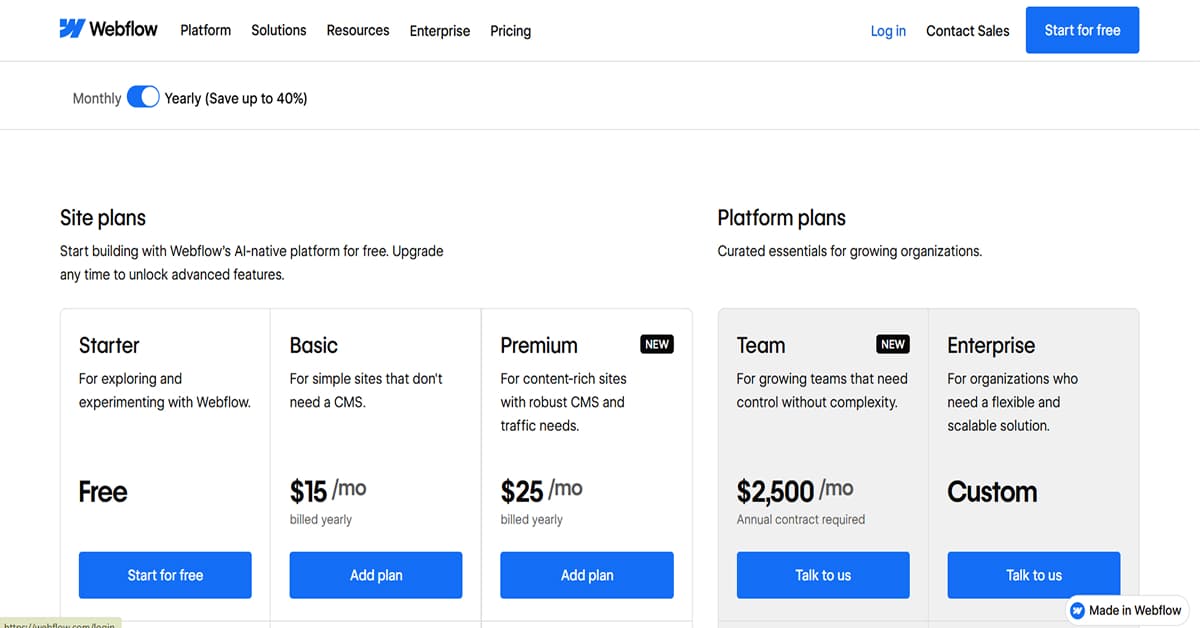
Looking over what this designer framework costs your company usually brings a few surprises once you calculate the tier structures. If you keep an eye on your monthly software overhead, Webflow does not provide a single, straightforward upgrade line. Instead, the dashboard splits your choices between individual Site tiers or collaborative Platform structures right away.
Let's look at the individual single-site hosting tiers first. You can start publishing test pages for zero dollars on their Starter plan. It costs Free to use. It works fine if you just need an informal playground to figure out how their visual sidebar mechanics function.
The real business discussion begins at the Basic plan level, which requires an investment of $25 per month if you choose their standard month-to-month billing cycle. This tier allows your company to connect a custom web domain. The main issue here is that the bracket strictly targets simple sites that don't need a CMS. What is the structural tradeoff for your business? You are left with completely flat, static pages. You cannot build dynamic article feeds or connect structured database rows on this plan.
To unlock actual dynamic database capabilities, you have to choose the Premium tier. That plan will cost you $39 every month if you choose their standard rolling month-to-month billing. This bracket is built specifically for content-rich sites with a robust CMS and heavy traffic needs. If your brand plans to run an organic marketing strategy with dynamic team directories, complex resource hubs, or regular blog updates, this is your actual baseline entry tier.
The platform branches off into an entirely separate budget universe if you look at their organizational team options. If your company houses a growing internal production crew, their entry-level Team tier demands a staggering $2,500 per month and requires a mandatory annual contract commitment. This tier unrolls curated essentials for growing organizations that need advanced workspace control without excessive complexity.
For larger corporate needs, they route you directly to their Enterprise tier, which operates on custom contract terms. Upfront, these entry numbers look much higher than basic automated tools, but you have to look at your long-term scaling needs to see if their deep data flexibility matches your engineering layout goals.
Wix Pricing
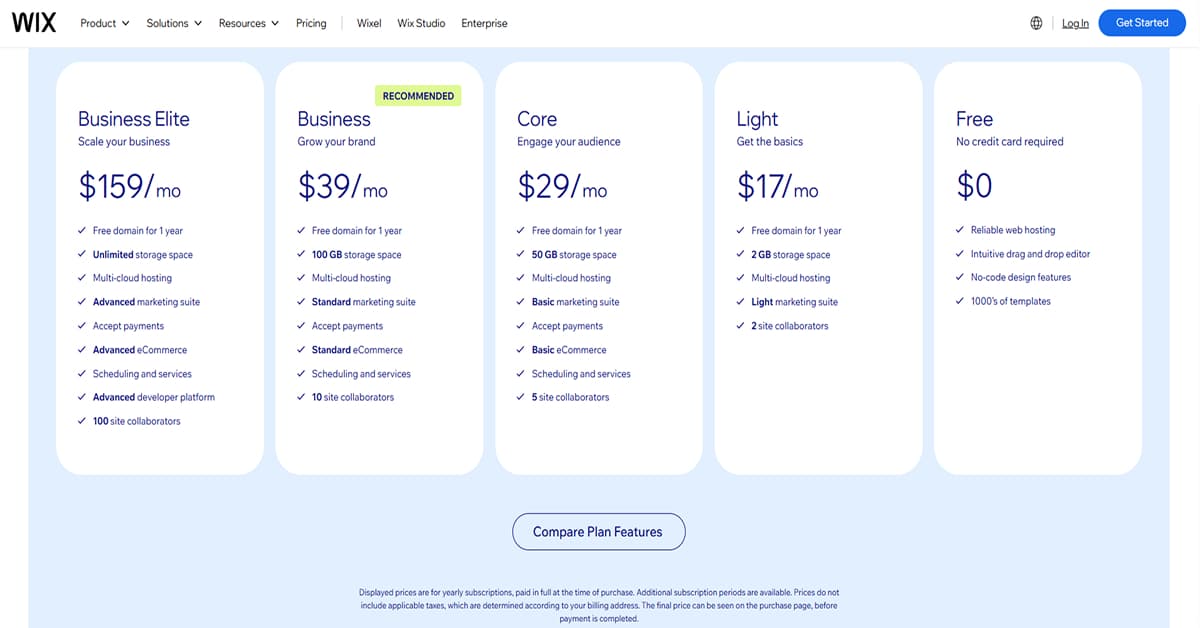
Wix structures its pricing around fixed monthly tiers tied to annual commitments. Would you prefer this payment structure?
Wix offers a basic free plan, but it comes with a major catch: you are stuck using a generic Wix subdomain and have no control over your own branding. For a professional business setup, you will need to jump immediately to the Light tier, which runs about $17 a month. This level removes the Wix ads, gives you a free custom domain for your first year, and lets you add two team members.
The real shift happens when you want to accept online payments or run an online store.
You will have to upgrade to the $29-a-month Core tier just to open up standard checkout features. This option also bumps your storage to 50 GB and gives you five staff accounts. Pretty good if you ask me.
For growing brands, the Business tier costs $39 a month, offering 100 GB of space, advanced marketing tools, and ten team logins. Neat! If your traffic and sales skyrocket, you might eventually need the Business Elite plan at $159 a month. This top option removes storage limits completely and opens up full developer access for up to a hundred users.
However, there is a massive financial catch with this model compared to open-source alternatives.
Every single landing page, portfolio, or storefront you build requires its own individual premium subscription. You cannot share one paid plan across multiple client sites or separate projects. If you are managing multiple clients, these individual bills add up incredibly fast, creating a massive monthly overhead that bites heavily into your agency's actual profit margins.
The verdict?
The final verdict comes down to your production volume and engineering requirements.
SEO
Why does search engine optimization always look so simple on a software marketing page? Think about your ranking stability. A platform can promise perfect search placement, but your visibility completely tanks if you cannot configure a clean technical fallback when a critical URL structure breaks.
Wix handles search optimization through an integrated, automated setup. The core engine guides you through a sequential setup wizard from the dashboard. Creating custom schema markups, managing global canonical tags, and running bulk 301 redirects happen inside a highly visual interface. They have spent considerable development resources expanding their indexation speed, utilizing direct API partnerships with search engines to submit pages for crawling immediately. But that automated approach has real structural boundaries. The underlying framework still injects additional platform resources and script assets that you cannot touch or remove manually. You are largely limited to how Wix delivers and optimizes its platform code scripts.
Webflow treats search visibility as a direct reflection of clean front-end architecture. The platform does not give you a hand-holding configuration wizard. Instead, Webflow gives you a flexible foundation where you build semantic HTML structures block by block. The browser parses your site instantly because the layout engine outputs exceptionally lean code. That lack of platform asset overhead gives you a massive advantage when aiming for top-tier mobile Core Web Vitals scores. You manage custom tracking code, robot rules, and indexing directives entirely manually inside your project settings. Why does that matter for your indexing strategy? It means you have explicit control over your asset loading priority. You can choose exactly when a third-party script fires so it never blocks the initial layout render.
What is the reality for your operational workflow? Wix gives you rapid optimization setup out of the box because the technical configurations and site maps are fully managed by the system. It is reliable, fast to deploy, and perfectly suited for standard business sites that do not require specialized code optimization. Webflow approaches search optimization from a visual engineering standpoint. It demands a much stronger understanding of web design mechanics and semantic data structures, but in return you get exceptional control over your site's technical architecture, file size, and responsive execution speed.

Domains & Emails
Wix keeps your domain configuration tied tightly to its primary workspace ecosystem. You buy a name straight through their billing panel. When you purchase a domain through Wix, the platform automatically configures it for your website.
If you connect an existing domain from an outside provider, you can connect it using either nameservers or DNS pointing. They connect you directly to Google Workspace for custom addresses. Everything lives on a single invoice. It saves real setup time. But this managed environment has clear boundaries. You have very little control over the underlying hosting infrastructure. Why stick with it? It works fine if you just need a standard business portal live by dinner time.
Webflow separates domain management from hosting. You register your domain with a third-party provider, then connect it to Webflow by configuring the required DNS records. You cannot buy a domain name directly from Webflow. You manage registration on Namecheap or Cloudflare instead. You copy the specific records yourself. You enter the required DNS records into your DNS provider's dashboard.
Webflow does not handle business mail packages either. You will configure the MX, SPF, and DKIM records provided by your email service inside your DNS provider's dashboard. Why take the extra steps? Because it gives you greater independence over your domain and email infrastructure. Your domain and email infrastructure remain independent of your website platform.
Let us look at the final judgment call. Wix packages everything into a predictable bundle so you can deploy standard business websites and client storefronts without tracking separate software fees. It delivers immediate convenience. Webflow treats site architecture as a visual web engineering task. It forces you to manage a fragmented infrastructure setup across separate providers, but in return you keep much greater control over your domain, DNS configuration, and email infrastructure while keeping them separate from your website platform. That separation gives you more flexibility if you ever need to change hosting providers or move parts of your infrastructure later.
Final Verdict
Webflow vs Wix? Honestly, it depends on what you need.
Both website builders are so popular, so deciding which is the best tool is much more difficult.
So, which provider has the most chance of earning your loyalty in the long run? Which one performs better across all user groups? What are the strengths and shortcomings of both website builders that distinguish them from the competition?
Here’s a tip.
Wix is one of the most popular and effective web design systems available. Webflow is a lesser-known band. Both have fantastic benefits, but choosing the wrong one for your situation could cost you much money.
Overall, both options have surpassed my expectations, and I would love to see how nicely they work for you too.